How many calories does VR burn?
From about 3.8 METs in one Beat Saber study to about 8 METs in a VR boxing and flow workout. How to turn that into calories, and why trackers disagree.
By EncidXVII, .
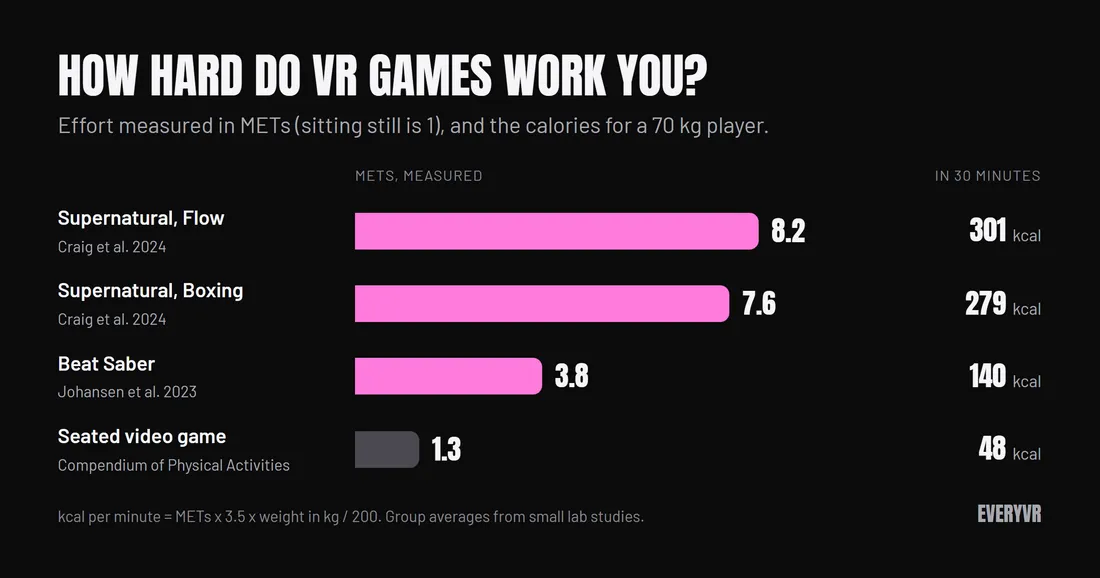
It depends on the game and on you. In lab studies with a metabolic cart, one VR fitness game measured about 7.6 to 8.2 METs, which its authors class as vigorous activity, while 30 minutes of Beat Saber at a self-chosen level measured 3.8 METs. Any number a tracker shows you, SweatXR included, is an estimate.
The unit: MET
A MET (metabolic equivalent) is a measure of effort. One MET is roughly the energy you use sitting quietly, defined as 3.5 ml of oxygen per kilogram of body weight per minute, or about 1 kcal per kilogram per hour (Compendium of Physical Activities). An activity of 6 METs uses six times as much energy as sitting.
To turn METs into calories, the Compendium gives this conversion (unit conversions):
kcal per minute = MET x 3.5 x body weight in kg / 200
So the same game burns more for a heavier player, and the MET value is what lets you compare games.
What studies have measured
Two published studies measured energy use in commercial VR games with indirect calorimetry, which works it out from the oxygen a player uses. Both use it as the reference against which other estimates are judged.
| Game and mode | Measured | Who | Session | Source |
|---|---|---|---|---|
| Supernatural, Flow | 8.2 METs (mean) | 23 young, active adults, mean age 25 | About 15 minutes, medium intensity | Craig et al. 2024 |
| Supernatural, Boxing | 7.6 METs (mean) | 21 of the same adults | About 17 minutes, medium intensity | Craig et al. 2024 |
| Beat Saber | 3.8 METs (mean) | 8 adults, mean age 25 | 30 minutes, self-chosen level | Johansen et al. 2023 |
Put through the formula above for a 70 kg player (an example weight, not a figure from the studies):
| Game and mode | METs | kcal per minute, 70 kg | kcal per 30 minutes, 70 kg |
|---|---|---|---|
| Supernatural, Flow | 8.2 | 10.0 | 301 |
| Supernatural, Boxing | 7.6 | 9.3 | 279 |
| Beat Saber | 3.8 | 4.7 | 140 |
These are group averages from small samples of young, fit people. Your own number will differ with your fitness, your weight, the level you play and how hard you swing. Measured kcal varied between players: in the Supernatural study, the average session was 151 kcal for Flow and 160 kcal for Boxing, with a standard deviation of about 36 and 39 kcal.
Seated games are at the other end. The Compendium of Physical Activities lists a seated video game with a handheld controller at 1.3 METs (video games, code 22040), barely above sitting still. For a 70 kg player that is about 1.6 kcal per minute.
Why headset-only estimates are rough
The 2024 study in JMIR Serious Games, Examining and Comparing the Energy Expenditure of Two Modes of a Virtual Reality Fitness Game (Supernatural), compared the metabolic cart with three kinds of tracker worn at the same time. As a share of the calories the cart measured:
| Tracker | Flow | Boxing |
|---|---|---|
| The headset’s own activity tracker | 83% | 64% |
| A research accelerometer on the waist | 45% | 56% |
| A smartwatch on the wrist | 108% | 112% |
The headset’s own tracker undercounted both modes, by about a sixth in Flow and by about a third in Boxing. The waist accelerometer missed about half. The smartwatch came closest, a little over. The study ran on one headset with one game and 23 people, so it shows the size of the problem, not a correction factor.
Heart rate is not a cure either. In the Beat Saber study (Johansen et al. 2023), two equations that estimate calories from heart rate gave on average about 115 and 141 kcal more than the lab measured over the 30 minutes. A wrist accelerometer was closest on average there, but spread widely between players.
How SweatXR handles this
SweatXR counts calories in any SteamVR game and says plainly that the number is an estimate.
- With a Bluetooth LE heart rate strap, it uses the equation of Keytel et al. (2005), from heart rate, weight, age and sex. The target is within about 20% of a dedicated fitness watch.
- Without a strap, it maps the speed of your head and hands to METs. The target is within about 35%.
- After 20 minutes with a strap, it fits your movement to your own heart rate, and uses that fit when the strap is off.
- Only time in play counts. Menus and the idle minutes before a session ends are left out.
SweatXR is not a medical device. The calories guide has the method in full.
Sources
- Craig TV, Rhodes RE, Sui W. Examining and Comparing the Energy Expenditure of Two Modes of a Virtual Reality Fitness Game (Supernatural): Indirect Calorimetry Study. JMIR Serious Games, 2024;12:e53999.
- Johansen JM, Schutte KVdI, Bratland-Sanda S. Large Estimate Variations in Assessed Energy Expenditure and Physical Activity Levels during Active Virtual Reality Gaming: A Short Report. International Journal of Environmental Research and Public Health, 2023;20(2):1548.
- Keytel LR et al. Prediction of energy expenditure from heart rate monitoring during submaximal exercise. Journal of Sports Sciences, 2005;23(3):289-297.
- Compendium of Physical Activities: the definition of a MET and the conversion to kcal per minute, and video game MET values.